
Python Career Paths for Beginners
You do not need to master Python before you can become employable with it. You need one honest skill you can prove and one small, finished project that…

Key topics
You do not need to master Python before you can become employable with it. You need one honest skill you can prove and one small, finished project that shows it working. That is the whole trick to a beginner Python career: pick a lane, build something real, and let the output speak.
The decision rule that carries through this guide is simple: choose a path by the kind of problem you want to solve, then prove it with one small, finished project. Everything below is organized around that test.
What Python Actually Gets You
Python is a strong first language because it lets you focus on the problem instead of the ceremony. Its syntax reads close to plain English, so your early hours go into learning how to think in code rather than fighting punctuation rules.
That readability pays off across the job market. Python shows up in web development, data analysis, automation, and software testing, which means the same core skills open several different doors. You are not betting your learning time on a single narrow role.
Here is the mental model most beginners miss: Python is a foundation, not a job qualification by itself. Every role stacks domain tools and work habits on top of the language. So the right question is not "which Python job pays best" but "which kind of problem do I want to solve every day."
If you are brand new, start with the basics before worrying about careers. A clear picture of what Python is and why it is popular will make every later decision easier.
Knowledge check
Check your understanding
Answer this question before you continue.
Choosing a Path by the Work You Want to Do
The table below maps each realistic entry point to the work it involves, the first additional skill to learn, and one tightly matched proof project.
| Path | What the work is | First skill to add | Proof project |
|---|---|---|---|
| Junior Python Developer | Write, test, and maintain code; fix bugs and build features on a team | Functions, modules, and reading other people's code | A small command-line tool that solves a real task you have |
| Data Analyst | Collect, clean, and analyze data; turn numbers into decisions | Pandas and basic data cleaning | A chart built from a public dataset, with a short write-up of what it shows |
| QA Tester | Write automated tests that catch bugs before users do | Writing test cases and reading error output | A test script that checks a simple program and reports pass or fail |
| Web Developer | Build websites and web apps, often with Python on the back end | One framework, like Flask or Django | A to-do list or simple form app that stores and shows data |
| Automation Specialist | Write scripts that remove repetitive work from business or IT tasks | File handling and working with the command line | A script that renames files or cleans up a folder automatically |
Notice what each path has in common: Python gets you started, but the first additional skill is what makes the work distinct. A data analyst learns Pandas. A QA tester learns how to write and read tests. A web developer learns a framework.
How to Tell the Lanes Apart Before You Commit
An absolute beginner often cannot tell what cleaning data, writing tests, or building back-end features actually feels like. So before you commit, compare the lanes by what goes in, what comes out, and what frustrates you when it breaks:
- Junior Python developer works on features and maintenance. Input is a codebase and a task; output is working, readable code that other people keep using.
- Data analyst works on data. Input is messy spreadsheets or files; output is a cleaned table and a chart that answers a question.
- QA tester works on behavior. Input is a program and an expectation; output is a pass or fail report that catches a bug before a user does.
- Web developer works on requests and responses. Input is a browser action; output is a page or app that stores and shows data.
- Automation specialist works on repetitive workflows. Input is a boring, repeatable task; output is a script that does it without you.
Knowledge check
Check your understanding
Answer this question before you continue.
Run One Micro-Task Before You Choose
Here is the practical test: pick two lanes that sound interesting, then run one tiny sample task from each before you choose. Keep each task deliberately small — one input, one transformation, one visible result.
- If data sounds good, load a small CSV and print a summary of one column.
- If web sounds good, build a page that stores and shows one value.
- If testing sounds good, write a test that checks one function and prints pass or fail.
The stopping rule is simple: choose the lane whose micro-task you could explain to someone else and wanted to extend. You are not choosing a permanent career identity. You are choosing a first experiment, and the experiment will tell you which daily problem you actually enjoy.
As you grow, you can move toward data science, machine learning, cybersecurity, or cloud engineering. Those are later specializations that build on one of the entry paths above, not separate starting lines. You do not need to choose a specialty on day one.
Knowledge check
Check your understanding
Answer this question before you continue.
Skills That Actually Matter for Entry-Level Python Jobs
You do not need a computer science degree or a decade of experience. You need a focused set of skills you can demonstrate:
- Core Python: Variables, data types, functions, loops, and organizing code into modules.
- Problem-solving: The ability to break a confusing task into smaller, testable steps.
- Basic tools: The command line, Git for tracking changes, and a simple database like SQLite.
- Clear communication: Explaining your code and asking good questions matters more than most beginners expect.
Here is the part beginners often miss: employers hire people who can show a working result, not people who have memorized the most functions. A small finished project beats a long list of half-learned topics.
A Staged Sequence That Keeps You Unstuck
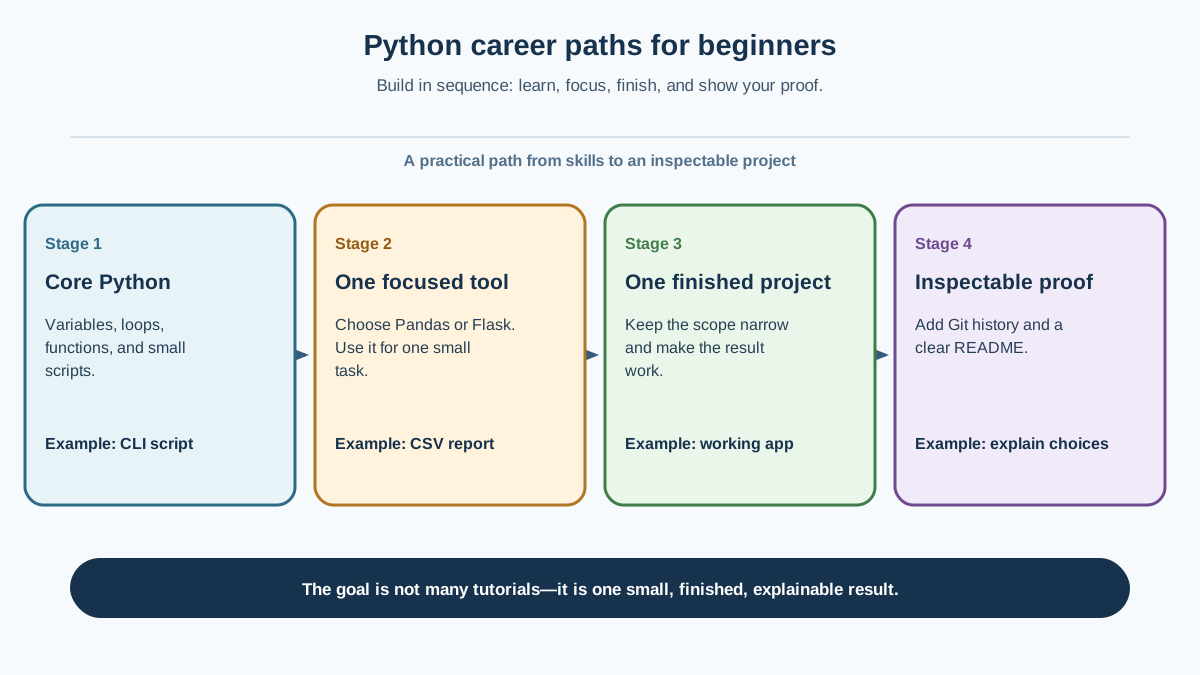
Do not try to learn every tool at once. Introduce them in an order where each one builds on the last:
- Core Python and small scripts first. Get comfortable with functions, lists, files, and basic debugging before touching a framework.
- Then one path-specific tool. If you chose data, learn Pandas. If you chose web, learn Flask. One tool, not five.
- Then build one project with that tool. This is where the learning becomes proof.
- Then add Git and documentation as you refine the project, so employers can inspect what you built.
Learning Python is a loop, not a race. The fastest progress comes from a short cycle: learn a little, run it, break it, fix it, and move on. Practice on a schedule — even twenty minutes of real coding most days beats a marathon session once a month. Read errors as clues: a traceback is not a failure; it is the program telling you exactly where your assumption broke. When you hit a confusing error, do not guess. Read the message, trace the state, and fix the assumption. That habit is what separates people who finish projects from people who restart them.
Knowledge check
Check your understanding
Answer this question before you continue.
Building a Project That Proves Your Path
Projects are your proof. They show employers what you can build, not just what you have watched. Pick the one project that matches the path you chose in the table above, and finish it completely.
Keep the first version deliberately narrow. Define the minimum success condition before you start:
- Data analyst: one dataset, one cleaned table, one chart that answers one question.
- QA tester: one program, one test script, one clear pass or fail report.
- Web developer: one page that stores and shows one value. Defer login, styling, and a database until after the first working version.
- Automation specialist: one repetitive task, one script that completes it.
- Junior developer: one command-line tool that solves one real task you have.
Whatever you build, make it inspectable. A credible first project should include:
- A clear README that says what the project does and how to run it.
- A runnable result — the program actually works when someone runs it.
- Sample input and output, or a screenshot where that makes sense.
- A note about one problem you solved, even a small bug you fixed.
That last point matters more than beginners expect. Employers are not looking for perfect code. They are looking for evidence that you can hit a problem, debug it, and keep going. A short note about a bug you found and fixed is worth more than a flawless project with no story.
Choose one project and finish it. A completed simple project is worth more than three abandoned ambitious ones. Then put it somewhere visible, like a GitHub profile, so employers can see your work in action.
Turning That Proof Into a Job Search
When you are ready to search, aim for roles that say "entry-level," "junior," or "intern." The same evidence rule applies here: every channel should surface work you can show, explain, run, and improve.
- Job boards: Search for "junior Python developer" or "Python intern" on major job sites.
- Internships: Many companies hire beginners to learn on the job and build connections.
- Freelance platforms: Small paid projects build experience and a track record.
- Networking: Meetups and online communities often surface jobs before they are posted publicly.
Formal credentials are not the only way to demonstrate ability, but requirements vary from role to role. Read each posting for the fundamentals it lists, and pair an application with an honest check of whether you can show those skills. A willingness to learn, backed by a finished project, is a real qualification — but it is strongest when the project matches the role you are applying for.
Frequently Asked Questions
What is the difference between a Python developer and a web developer? A Python developer writes Python code for many purposes, including web development, data analysis, and automation. A web developer focuses on building websites and web apps, and may use Python or other languages.
Do I need a computer science degree for a Python job? No. Many entry-level roles are open to people who learned through courses, bootcamps, or self-study. A portfolio of finished projects often matters as much as a degree, and the projects you can explain carry more weight than the credential alone.
How do I know when I am ready to apply? Judge readiness by observable evidence, not by a calendar. If you have one or two finished projects you can explain, and you can complete a small task, debug it, and talk about what you built, you are ready to start applying. Consistency matters more than speed.
What is Git and why do Python jobs expect it? Git tracks changes to your code over time. It helps you manage versions and collaborate with others, and most teams expect you to know the basics.
How do I show employers my Python projects? Put your code on a GitHub profile or a personal website with a short description of each project and what it does.
Your Next Step
Turn the choice into a test. Pick two candidate lanes from the table, run one bounded micro-task in each, and choose the lane whose work you can explain and want to extend. Then build the single minimum-viable proof project for that lane — one input, one transformation, one visible result — and finish it before adding anything else.
The path is not about knowing everything. It is about proving one thing you can do, then building on it. Choose your lane, run your first proof task, and let the output teach you what to learn next.
Knowledge check
Final check
Finish the article by checking the ideas you just learned.
References
Want a more structured Python path?
Use the Python Starter Pack to turn scattered tutorials into a focused practice path.
Python Starter Pack
A compact LearnPyFast PDF pack covering what Python is, installation, your first program, running Python code, and Python versions.
- 5 curated chapters
- Enhanced PDF edition with bundle-only learning guidance
- Offline-friendly format for focused review
- Source article links for future online updates
Coming soon


